FluSS: Fluency in Speech and Signing
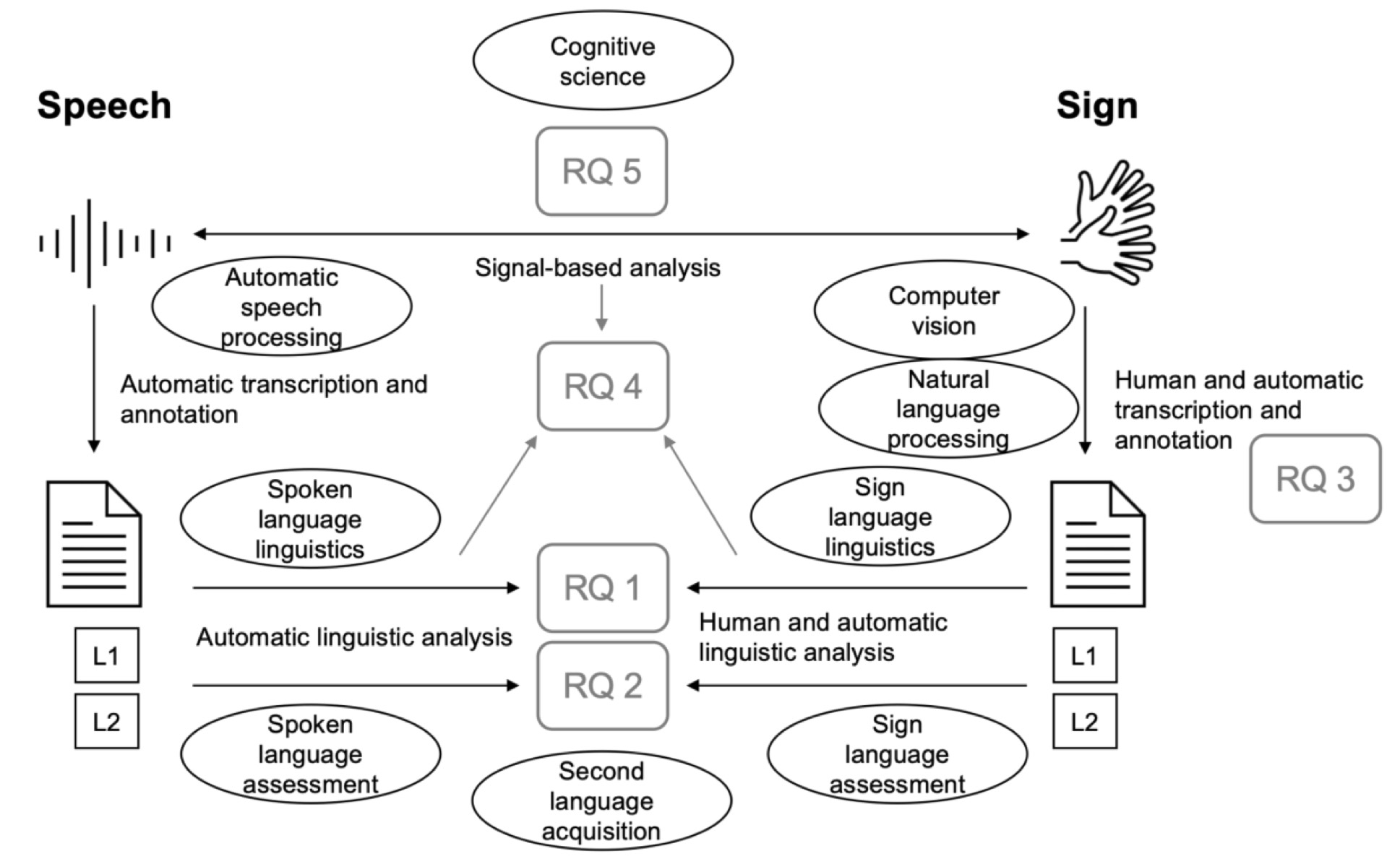
Fluency in spoken communication – the ability to speak with smooth and natural timing properties and speed – serves as the foundation for successful spoken interaction, enabling efficient and effective communication. It is one of the most salient features of spoken language proficiency. While fluency has been extensively studied in speech communication, the role of fluency in sign language—where language is conveyed exclusively through visual-spatial mode—remains largely obscure. The central aim of the present project is therefore to understand whether sign language relies on comparable utterance production and cognitive mechanisms as speech. We want to understand whether the mechanisms relevant for fluency in speech play a critical role in sign language fluency as well.
Funding
Swiss National Science Foundation
Collaboration
- Phonetics and Speech Sciences UZH (Prof. Dr. Volker Dellwo)
- University of Teacher Education in Special Needs (Interkantonale Hochschule für Heilpädagogik Zürich, HfH) (Prof. Dr. Tobias Haug)
- University of Leiden (Prof. Dr. Nivja de Jong)
UZH Language, Technology and Accessibility Lead
UZH Language, Technology and Accessibility Researchers
Project Duration
March 2026 to February 2030