Header

Search

Past Projects

Additional Information

IICT was a four-year project supported by the Swiss Innovation Agency (Innosuisse) under its flagship scheme, with a total budget of CHF 12.3 million. Its objective was to develop information and communication technologies (ICT) in the context of persons with disabilities. The project addressed five key application areas: text simplification, sign language translation, sign language assessment, audio description, and spoken subtitles, and successfully delivered innovative technologies and tools in these domains.

EASIER logo

EASIER

EASIER aims to create a framework for barrier-free communication among deaf and hearing citizens across Europe by enabling users of European sign languages to use their preferred language to interact with hearing individuals.

Three levels of simplified language: A1, A2, B1

capito automated

In this project, together with CFS GmbH ("capito") in Graz, Austria, we worked on semi-automatic text simplification for German with the aim of producing simplified German at levels A1, A2, and B1 according to the Common European Framework of Reference for Languages (CEFR). The output of our neural machine translation models is postedited by human translators.

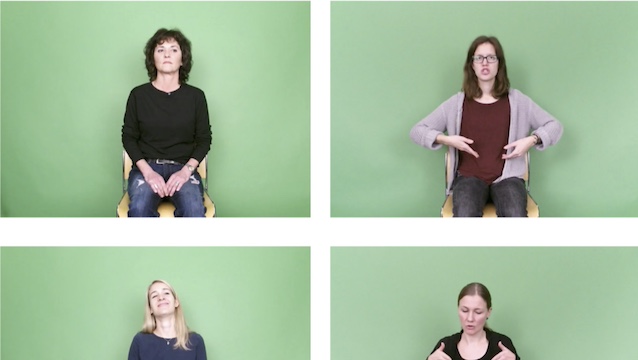
The goal of this project was to pioneer an assessment system for Swiss German Sign Language (Deutschschweizerische Gebärdensprache, DSGS) using automatic sign language recognition technology. To achieve this goal, the project used a multidisciplinary framework that followed two strands of research, one on sign language technology and one on sign assessment with a common link to sign language linguistics.

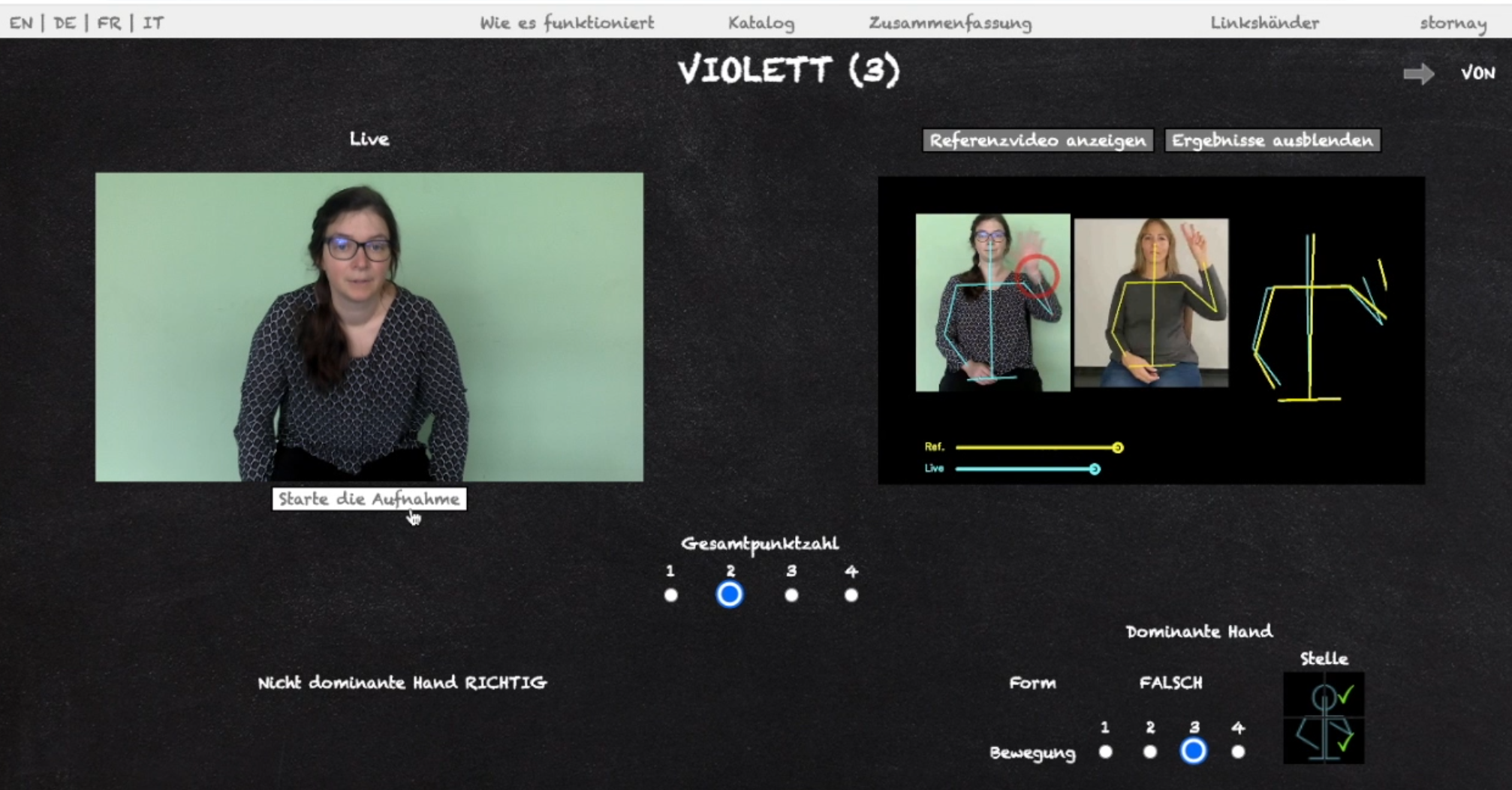
Screenshot SMILE II web interface showing a sign language learner on one side and a the learner together with a reference signer on the other side with overlayed skeletons. Below information on the score (number of points) achieved in signing a sign, here the sign VIOLETT (PURPLE). More detailed information on the performance of the dominant and non-dominant hand is provided.

SMILE II

SMILE II aims to research and build advanced technology for sign language learning. More precisely, the project builds on the groundwork of the SNSF Sinergia project SMILE I, which dealt with assessment of the manual activity of Swiss German Sign Language (Deutschschweizerische Gebärdensprache, DSGS) in isolated signs produced by L1 users and L2 learners. SMILE II extends this technology to continuous sign language assessment including both manual and non-manual components of signs so that a DSGS learner’s sentence-level production can be assessed in an automatic manner.

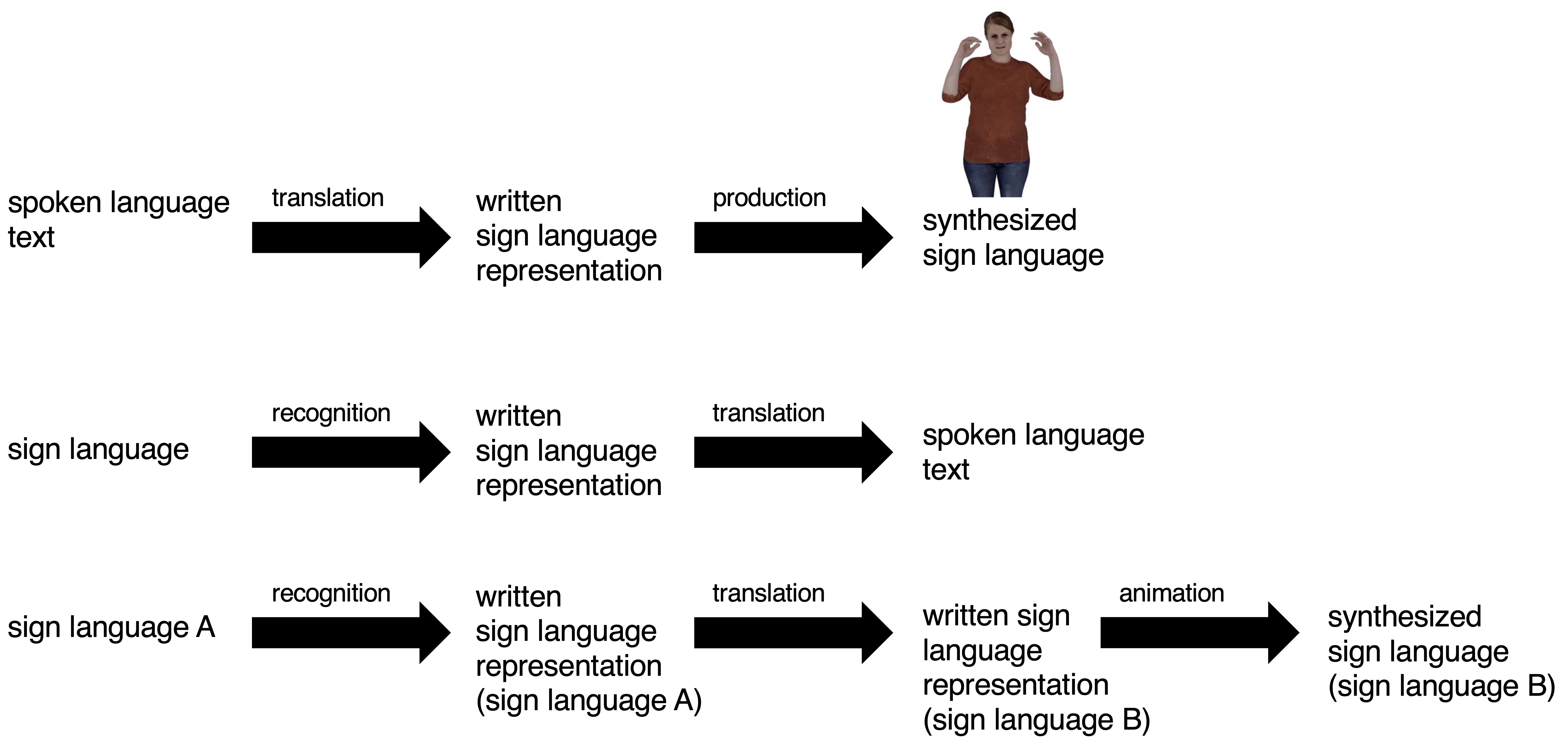
Overview of sign language translation pipelines

Machine Translation and Animation Assessment for DSGS

More about Machine Translation and Animation Assessment for DSGS

This two-part project dealt with Swiss German Sign Language. The first part involved sign language machine translation, the second sign language animation assessment, i.e., the evaluation of virtual signers, or 'avatars'.

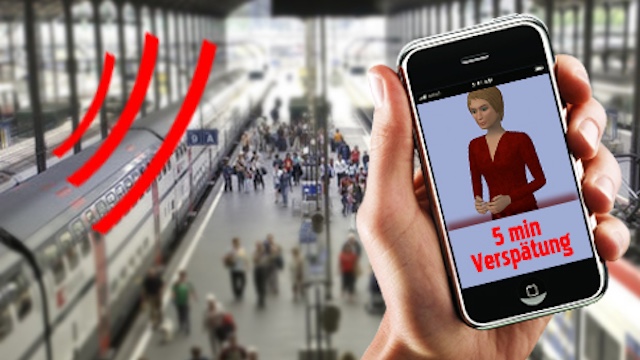
Mobile phone at a train station

Trainslate

In the Trainslate (=train+translate) project we developed a system that automatically translates German train announcements of the Swiss Federal Railways (Schweizerische Bundesbahnen, SBB) into Swiss German Sign Language. The idea for such a system was suggested to us by Deaf signers in Switzerland.